SFF, Micro and Tiny: the three business PC form factors explained
A specialist's guide to the three business desktop shapes on the UK refurbished market, with the trade offs on cooling, upgrade paths and real world use cases.
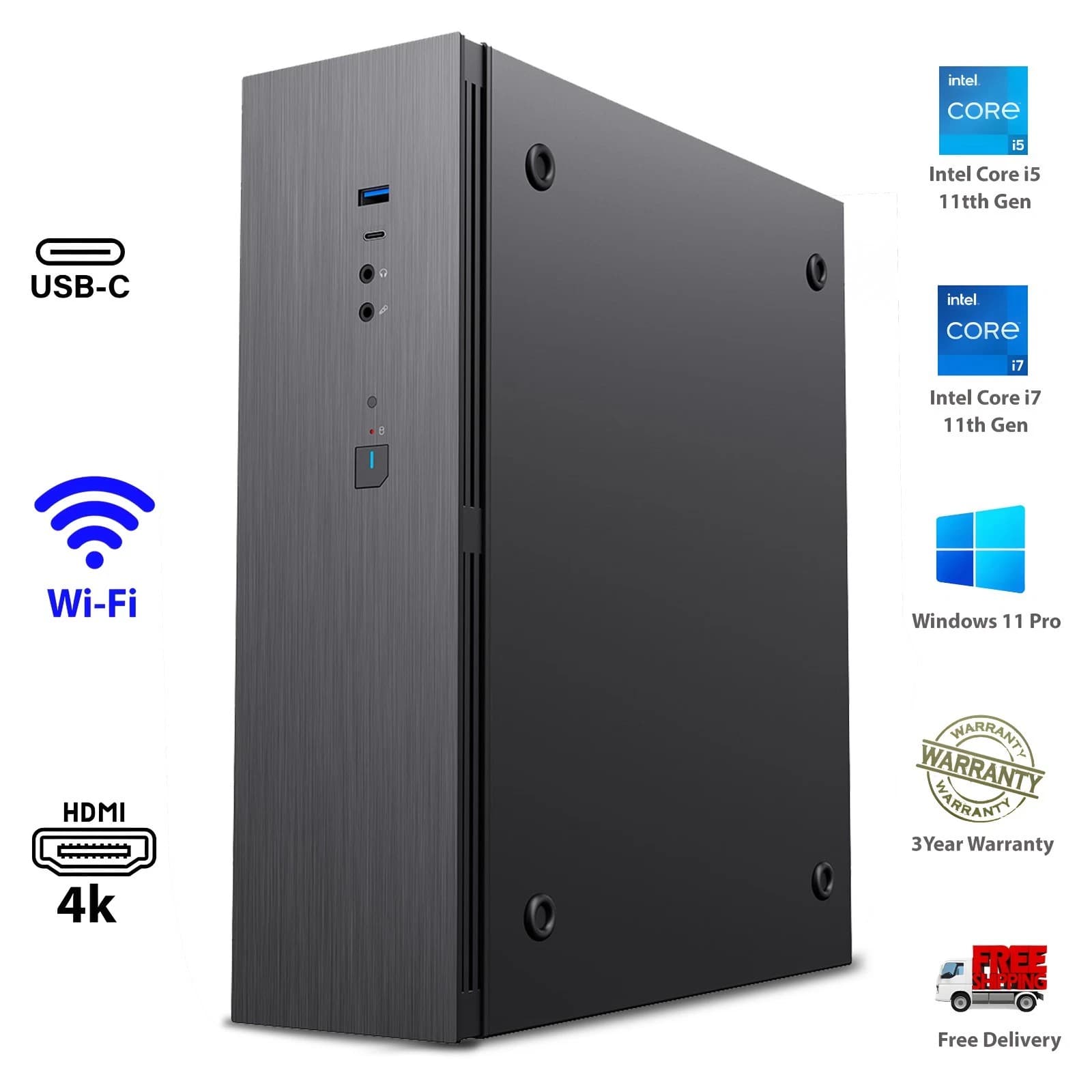
Walk into any UK office storeroom and you find three shapes of business PC: a chunky micro tower, a slim SFF (small form factor) box, and a tiny 1 litre unit that looks like a set top receiver. All three carry the same badges from Dell, HP and Lenovo, and all three sell for wildly different money on the refurbished market.
The names are marketing labels rather than engineering ones. The same OEM will happily put an i7 into all three chassis, though the thermal reality is very different.
The three form factors, by the numbers
A Micro Tower, sometimes labelled MT, is the closest to a traditional desktop. Chassis volume sits in the 15 to 22 litre range, with a full height 260 to 500 W PSU, a full length PCIe x16 slot, two or three 3.5 inch drive bays, and four DIMM slots.
An SFF chassis strips that down to roughly 8 to 12 litres. The PSU drops to a slim 180 to 260 W internal unit, the x16 slot is low profile only, drive bays shrink to one 3.5 inch and one 2.5 inch, and the DIMM count usually stays at four. Dell's OptiPlex 7020 SFF is 9.3 litres, HP's ProDesk 400 G9 SFF is 9.5 litres.
A Tiny, called Micro by Dell and Mini by HP, is a different animal. Chassis volume is 1.0 to 1.4 litres. There is no internal PSU; it runs from an external 90 to 230 W power brick. There is no PCIe slot. Storage is one M.2 NVMe plus one 2.5 inch SATA if you are lucky, and memory uses two SODIMM slots.
Cooling and the thermal ceiling
All three chassis will accept an i7, but only one can actually run it flat out.
The Micro Tower has room for a 92 mm tower cooler. A 65 W non-K i7 holds its full 219 W boost indefinitely, and a 125 W K part is viable if you accept the noise.
An SFF chassis uses a blower cooler ducted to the rear exhaust, engineered for 100 to 150 W of sustained package power. A 65 W i7 lives happily; a K part throttles after two to three minutes. Fan noise sits around 32 to 38 dB at load.
The Tiny chassis uses a laptop grade blower and a 15 mm heatsink. Package power ceiling is 35 to 45 W sustained. Any T suffix chip (i5-10500T, i7-10700T) fits this envelope. Put a full desktop i7 in a Tiny and it hits 100 degrees inside 90 seconds.
Upgradability, honestly
Micro Tower is fully upgradable. Full length GPU up to about 250 mm, extra drives, PSU swap, aftermarket CPU cooler.
SFF is partially upgradable. RAM to 64 or 128 GB depending on the board, NVMe swap, and a low profile GPU up to 75 W bus powered such as the RTX A2000 or Arc A380 LP. A PSU swap is possible but the connector is often proprietary.
Tiny is essentially a sealed unit. You can swap the M.2, add or replace SODIMM sticks, and change the SATA drive. No GPU path, no PSU upgrade. Buy the spec you need on day one.
Buy the tested unit
The specific unit these thermal figures came from is on eBay now, with a twelve month warranty and Windows 11 Pro activated.
Buy the tested BAV i7 10th gen SFF on eBay
Best form factor per use case
For a family PC in the living room, or a reception desk machine, Tiny is the right answer. Mount it behind the monitor with a VESA bracket. Just pick a T suffix CPU.
For a home office running Office, Teams, a browser with forty tabs and light Photoshop, SFF is the correct shape. Enough thermal headroom for a proper i5 or i7, small enough to sit on the desk, and one PCIe slot spare.
For a workstation that will see heavy virtualisation, CAD, video editing or local LLM inference, Micro Tower is the only sensible pick. The thermal ceiling matters, the GPU slot matters, and the extra case volume translates to lower noise at the same load.
SFF is the volume seller on the UK refurbished market for a reason: it fits 90 per cent of home and office use, at a fraction of the size and cost of a full tower.
The BAV i7 10th gen SFF, tested
The tested unit is a Dell OptiPlex 7080 SFF or an HP EliteDesk 800 G6 SFF depending on stock, both with an Intel Core i7 10700 (8 cores, 16 threads, 65 W base, 4.8 GHz boost). Listings ship with either 16 GB or 32 GB DDR4 3200, and either a 256 GB, 512 GB or 1 TB NVMe. Windows 11 Pro is preactivated.
Idle wall power measures 28 W. Cinebench R23 multi core lands at 12,800 to 13,200 points, holding all 8 cores at 3.9 to 4.1 GHz for a ten minute run. Package temperature stabilises at 84 degrees. Fan noise at load is 34 dB at one metre.
Compared to a new Dell OptiPlex Micro Tower with an i5 13500 at £689, the tested unit costs less than a third for a similar multi core score.
Frequently asked questions
Is a Tiny PC quiet enough to sit on a desk during a Teams call?
Yes, provided the CPU is a T suffix part and the workload stays under 30 W. A 10th gen i5-10500T in an HP EliteDesk 800 G6 Mini idles silently and only spins up audibly during a video export or a Windows update.
Can I add a discrete graphics card to an SFF business PC?
Yes, within limits. The slot is low profile, and any card must run from the 75 W the PCIe bus provides because there is no supplementary power connector. Suitable cards are the RTX A2000 low profile, Intel Arc A380 low profile, and Quadro T1000.
Why do refurbished 10th gen units still cost meaningful money in 2026?
Intel 10th gen is on the Windows 11 supported CPU list. It runs Windows 11 24H2 with full security updates through to at least October 2031. That extends the useful life of a 10th gen SFF by five years compared to an 8th gen unit.
Is DDR4 in a 10th gen SFF a problem in 2026?
Not for a home office. DDR4 3200 is the platform standard, kits are cheap on the UK second hand market, and the practical performance gap to DDR5 for browser, Office and Teams workloads is under 5 per cent.
What is the smallest business PC that still runs a full desktop CPU?
An SFF chassis around 9 to 12 litres. Below that, thermal envelope forces the shift to laptop grade cooling and T suffix chips.
About Birmingham AV
We are a Bromsgrove specialist in refurbished laptops and desktops, based in Worcestershire. Companies House 12383651, VAT GB 348755066. Across our eBay presence we have sold 87,000 items since 2017 with 24,756 buyer feedbacks at 98.9 per cent positive, making us one of the highest volume refurbished PC operations on eBay UK. Every unit ships with a twelve month return to base warranty; if it fails within that period we cover the return leg and either repair or replace it.