DDR4 versus DDR5 in 2026: do you actually need the upgrade?
DDR5 wins the benchmark charts, but the FPS gap at 1440p is smaller than the price gap. Here is when a DDR4 platform still makes sense in 2026, and when it does not.
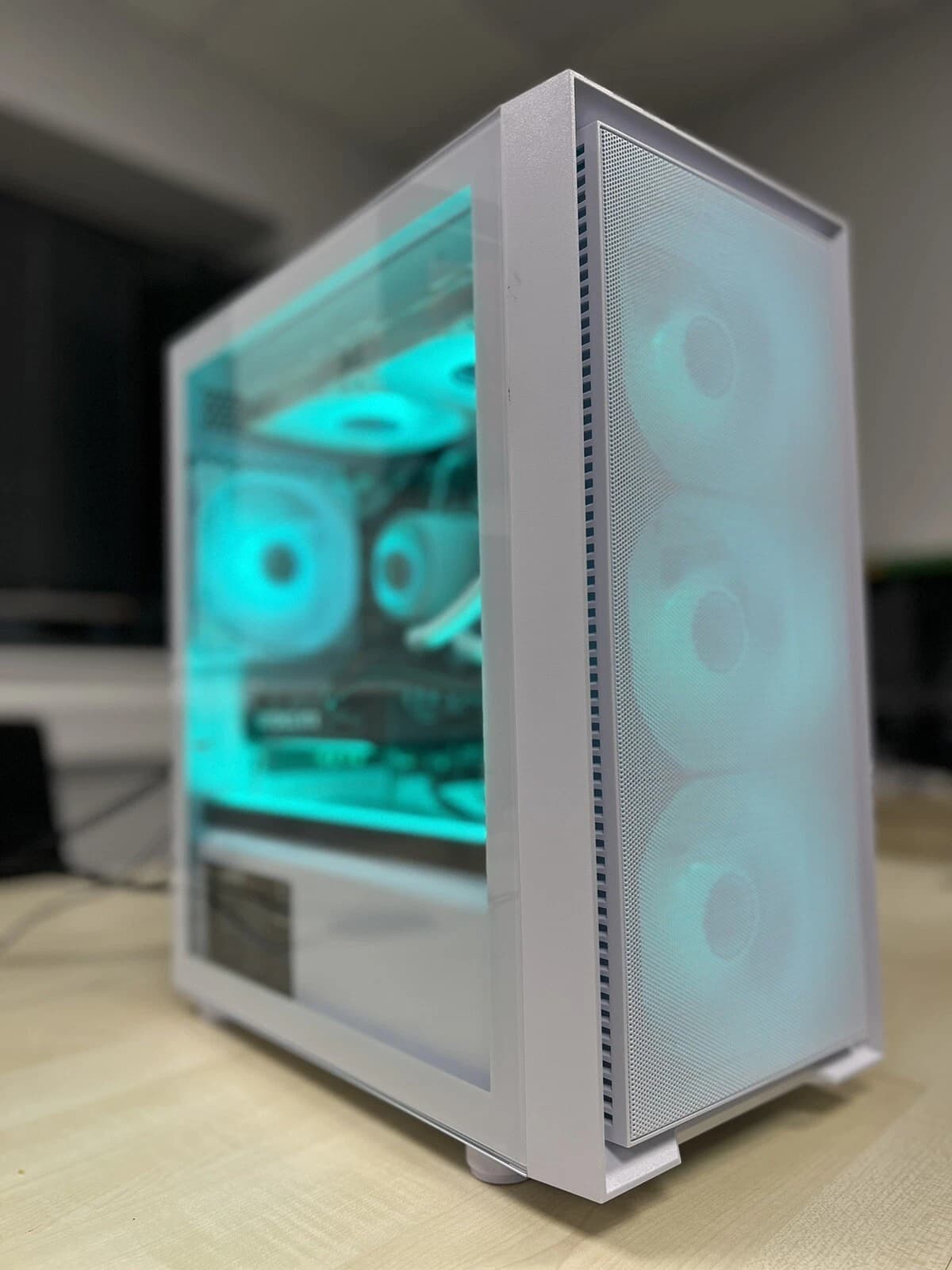
Every second build enquiry through the workshop in Bromsgrove asks the same question. Should the new machine be DDR4 or DDR5? The answer in 2026 is less obvious than the memory manufacturers would like. DDR5 has matured and prices have come down, but DDR4 has not gone away, and on the right chip it still keeps up. This piece is for the buyer who has a budget, a use case, and no interest in paying for headroom they will not use.
What has changed since 2024
DDR5 launched with three problems: latency was worse than mature DDR4, prices were roughly double, and early platforms had memory training quirks that made cold boots unreliable. By mid 2026 all three have softened. Retail 6000 MT/s CL30 kits from Kingston, G.Skill and Corsair now sit around £75 for 32GB.
DDR4 has not stood still. High binned 3600 MT/s CL16 kits are available for £45 for 32GB, and the platforms hosting them (AMD X570 and B550, Intel Z590 and B560) are cheap on the used market and completely proven.
Gaming FPS at 1080p and 1440p
At 1080p with a fast GPU the memory subsystem matters. Independent testing across 2025 and early 2026 puts a Ryzen 7 7800X3D on DDR5 6000 CL30 roughly six to nine percent ahead of a Ryzen 7 5800X3D on DDR4 3600 CL16 in a twelve game average, covering Cyberpunk 2077, Spider Man Remastered, Baldur's Gate 3 and a run of esports titles.
At 1440p that gap narrows to three to five percent. At 4K, once the GPU becomes the bottleneck, the two systems are usually within one frame. The pattern is consistent: the higher the resolution, the smaller the memory delta.
Absolute numbers, using an RTX 4070 Ti Super: Cyberpunk 2077 at 1440p ultra with DLSS Quality returns 118 to 124 fps on DDR5 and 113 to 118 fps on DDR4. Counter Strike 2 at 1080p returns 380 to 410 fps on DDR5 and 350 to 380 fps on DDR4.
Simulators are the exception. Microsoft Flight Simulator 2024, Star Citizen and heavily modded ARMA 3 lean on memory bandwidth harder than most titles, and the DDR5 lead can widen to twelve or fifteen percent.
Content creation and productivity
Adobe Premiere Pro timeline scrubbing on 4K H.265 footage benefits from DDR5 bandwidth. Puget Systems scores put a 7700X on DDR5 6000 roughly fourteen percent ahead of a 5700X on DDR4 3600 for the extended overall score. DaVinci Resolve behaves similarly, with the biggest gaps on noise reduction and Fusion composites.
Compilation is more mixed. A Linux kernel build shows a six to eight percent DDR5 advantage; Visual Studio on a mid sized C++ project shows four to seven percent; Blender CPU rendering shows two to three percent. Excel with heavy Power Query models is the surprise: recalculating a workbook with several million rows can be twenty to twenty five percent faster on DDR5.
Buy the tested unit
The current pick from the bench is the Ryzen 7 7700 build with 32GB of DDR5 6000 CL30 and an RTX 5070. Benchmarked, burn-in tested, twelve month warranty.
See the tested Ryzen build on eBay
When DDR4 is still the correct answer
Three scenarios keep DDR4 on the recommendation list in 2026.
First, the Ryzen 5000 upgrade path. A buyer with an existing AM4 board, a 5600 or 5700X, and 16GB of DDR4 can drop in a 5800X3D or 5700X3D for £180 to £220, add a second 16GB kit, and land within a handful of frames of a full AM5 rebuild that would cost £600 to £800 more.
Second, the budget desktop under £700. A Ryzen 5 5600, B550 board, 32GB of 3600 CL16 DDR4 and a Radeon 7700 XT delivers 1440p sixty to ninety fps in modern titles and leaves budget for storage and a proper PSU.
Third, media servers, home labs and general household machines. Neither memory generation will be the bottleneck, so buy the cheaper platform.
When DDR5 is worth the platform jump
Buy DDR5 if the machine is a fresh build with no AM4 parts to reuse. Buy DDR5 if the workload is video editing, code compilation on large projects, or finance modelling. Buy DDR5 if the intended GPU is an RTX 5080, 5090 or Radeon 9070 XT, because at that tier the CPU and memory subsystem must keep up or the graphics card will sit idle. Buy DDR5 if the plan is to run the machine for five to seven years: the platform still has a generation or two of CPU upgrades ahead of it, and AM4 does not.
Ryzen 5000 on DDR4, Ryzen 7000 on DDR5
Ryzen 5 5600, Ryzen 7 5700X, Ryzen 7 5800X3D and Ryzen 9 5900X all sit on AM4 with DDR4. Ryzen 5 7600, Ryzen 7 7700, Ryzen 7 7800X3D and Ryzen 9 7900X sit on AM5 with DDR5. Intel 12th, 13th and 14th gen Core chips run either standard, though most boards commit to one or the other.
The cross platform winner for pure gaming remains the 7800X3D on DDR5. The value winner remains the 5800X3D on DDR4. With the same GPU, the 1440p frame rate difference is smaller than the price difference.
Frequently asked questions
Can I put DDR5 in a DDR4 motherboard?
No. The DIMM notch and electrical specification are not compatible. DDR5 requires a chipset that supports it: AM5 for AMD, or 600, 700 and 800 series chipsets for Intel. No adapter or firmware update will change this.
Is DDR4 3200 MT/s good enough or do I need 3600?
3600 CL16 is the sweet spot on AM4 because it lets Infinity Fabric run one to one with the memory clock on Ryzen 3000 and 5000 chips, giving three to five percent more fps than 3200 CL16. On Intel the gap is closer to one or two percent. If the price difference is under £10, take the 3600 kit.
What about DDR5 6400 or 7200 versus 6000?
Above 6000 MT/s the returns diminish quickly. 6400 CL32 is measurably faster than 6000 CL30 in a handful of titles. 7200 kits often force a fabric divider that undoes part of the gain. For most buyers 6000 CL30 is the correct pick.
Will 16GB still be enough in 2026?
For pure gaming, mostly yes, though several 2025 releases recommend 32GB. For content creation, or Chrome with fifty tabs plus Discord and OBS, 32GB is the floor. Memory is cheap enough that skipping to 32GB on a new build is the sensible default.
Should I wait for DDR6?
DDR6 is not expected in consumer platforms until late 2027 at the earliest, and the first generation will be expensive and immature, exactly as DDR5 was in 2022. A machine bought in 2026 will still be competent when DDR6 launches.
About Birmingham AV
Birmingham AV Ltd is based in Bromsgrove, Worcestershire. Companies House 12383651, VAT GB 348755066. We have sold 87,000 items across our eBay and direct channels, with 24,756 buyer feedbacks at 98.9% positive. Every desktop, laptop and workstation that leaves the workshop ships with a twelve month parts and labour warranty and a bench tested build sheet. If you would like a build specced to your workload, the team is on the phone.