Best streaming PC for Twitch OBS at 1080p60 in 2026
Streaming to Twitch at 1080p60 is a solved problem in 2026 if you pick the right encoder and leave real CPU headroom for the game. Here is the specialist take.
What 1080p60 actually asks of a PC in 2026
Twitch still caps most non partner channels at 6000 kbps and 1080p60. That target has not moved in years, but the games have. Warzone, Apex, Fortnite performance mode and the latest Call of Duty lean harder on the CPU than titles from three years ago, and OBS has to share that same silicon on a single PC setup.
The 2026 streaming build question is less about raw teraflops and more about encoder choice, sensible core allocation, and where the encode actually runs.
OBS encoders in 2026: NVENC, x264 and AV1
NVENC on Ada or Blackwell Nvidia cards is the default for single PC streaming. The dedicated NVENC block on an RTX 4060, 5060, 5060 Ti or 5070 handles 1080p60 H.264 at 6000 kbps with zero measurable impact on in game frame rate, because it lives on a separate part of the die from the CUDA cores. Image quality is within a few percent of x264 medium at the same bitrate.
x264 CPU encoding is still the reference for low bitrate quality. At veryfast it is roughly equal to modern NVENC. At medium or slow it pulls visibly ahead on complex scenes, but costs eight to twelve threads of your CPU, which is why x264 medium while playing a modern shooter is a dual PC job.
AV1 is the interesting arrival. Twitch enabled AV1 ingest for enhanced broadcasting in 2024. AV1 at 6000 kbps looks noticeably cleaner in motion than H.264 at the same bitrate, roughly matching H.264 at 8000 to 9000 kbps in perceived quality. Both RTX 40 and RTX 50 cards ship a hardware AV1 encoder. If your viewers can decode AV1, this is now the default choice.
CPU headroom while playing
The rule from 2020 still holds. Leave at least four physical cores untouched by OBS while you play. On an Intel Core i7 with eight P cores and eight E cores, or a Ryzen 7 with eight cores and sixteen threads, that is easy. On a Core i5 or Ryzen 5 with six cores it starts to bite once you add Discord, a browser, a chat overlay, StreamElements, and a game that spikes to twelve threads.
With NVENC or AV1 hardware encode, OBS CPU load is in the low single digit percents. The CPU handles scene composition, audio mixing, and the game. An eight core part with strong single thread performance is the sensible floor for a 2026 streaming build. Twenty threads on a hybrid i7 stays quiet even under sustained load.
Dual PC versus single PC in 2026
Dual PC made sense when x264 medium was the only way to get clean image quality and old NVENC was visibly worse. That was a decade ago.
In 2026 the case for dual PC is narrow. You want it if you are streaming 1440p60 or 4K60 downscaled with x264 slow, running heavy real time effects with multiple camera sources, or you are a partner who wants belt and braces separation. For 1080p60 Twitch to a normal audience with a modern Nvidia GPU, single PC with NVENC or AV1 is the right answer, and it saves the cost, desk space, the second capture card, and the extra keyboard.
Buy the tested unit here: Birmingham AV liquid cooled i7 RTX 5060 Ti streaming build on eBay.
The BAV liquid cooled i7 RTX 5060 Ti build
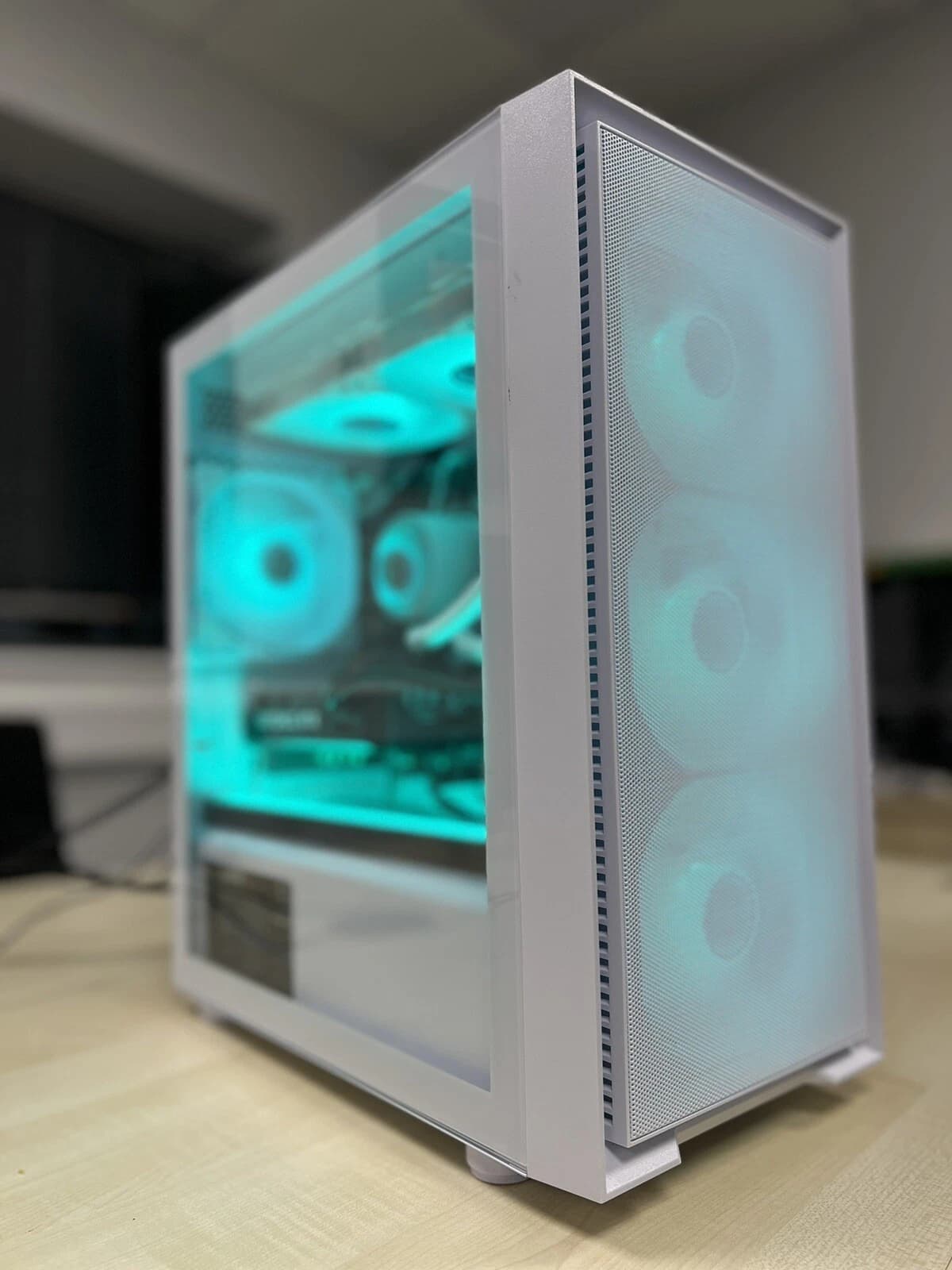
The recommended Birmingham AV configuration for 1080p60 Twitch streaming in 2026 is a liquid cooled Intel Core i7 paired with an RTX 5060 Ti. It hits the balance points that matter.
The i7 supplies sixteen or twenty threads depending on generation, leaving cores free for OBS, Discord and a browser. The 240mm AIO keeps sustained all core clocks high across long sessions, which is what a three or four hour stream demands. Air cooling can do it, but liquid cooling delivers quieter fans at the same package temperature, and quieter fans are picked up less by a desktop microphone.
The RTX 5060 Ti brings a Blackwell class NVENC block with AV1 encode. It renders modern esports titles well above 144 fps at 1080p, drives AAA games at 60 to 90 fps at 1080p or 1440p with DLSS, and handles the encode in parallel without a measurable frame time hit.
Storage across the current listings varies between 512GB and 2TB NVMe, with 16GB, 32GB or 64GB DDR4 or DDR5 RAM depending on the SKU. For a streamer, 32GB is the sensible default, and 1TB NVMe or larger is worth the small premium given how quickly modern game installs eat 100GB each.
OBS settings that matter
Video bitrate 6000 kbps CBR for standard Twitch, higher on enhanced broadcasting. Keyframe interval 2 seconds. NVENC preset P5 or P6 quality. B frames 2 on H.264, default on AV1. Audio 160 kbps stereo AAC.
Downscale filter Lanczos, output 1920 by 1080, 60 fps. If your game runs at 1440p or 4K, render at native and let OBS downscale for the broadcast. That produces cleaner text and edges than rendering the game at 1080p directly.
Frequently asked questions
Do I need a capture card for a single PC stream?
No. A capture card is only required when you have a separate gaming machine feeding a dedicated streaming machine, or when you are pulling video off a console. Single PC streaming with NVENC or AV1 is fully internal.
Is 16GB of RAM enough for streaming in 2026?
For light streaming of older or lighter titles, yes. For modern AAA games with a browser, OBS, Discord and a chat overlay running, 32GB is the sensible target. It is the single cheapest upgrade that removes stutters caused by paging.
Will an RTX 5060 Ti bottleneck a Core i7?
At 1080p60 in esports titles the GPU sits well within its limits and the CPU does the work, which is why the i7 matters. In AAA games at 1440p with DLSS Quality, the pair is well balanced. This is a genuine 1080p60 and 1440p streaming combination, not a marketing pairing.
Should I stream in AV1 or stick to H.264 on Twitch?
If you are on Twitch enhanced broadcasting and your card has an AV1 encoder, AV1 is the better choice. Motion is cleaner at the same bitrate. Fall back to H.264 NVENC only if you find viewers cannot decode your stream, which is now rare.
Does liquid cooling actually matter for streaming?
For raw performance, not much. For noise floor at the microphone, yes. A 240mm AIO is usually five to ten decibels quieter under sustained load than a tower cooler pushing the same power, which is audible on a cardioid mic.
About Birmingham AV
Birmingham AV has sold over 87,000 items on eBay UK since 2017, with 24,756 buyer feedbacks at a 98.9 percent positive rating, making us one of the highest volume refurbished PC operations on eBay UK. Every system ships with a twelve month warranty, is tested end to end before dispatch, and is supported by a UK team from our Bromsgrove Worcestershire facility. Registered at Companies House as company 12383651, VAT registered as GB 348755066.