The shift to NPU integrated CPUs and what it means
Every mainstream laptop CPU shipping in 2026 now includes a neural processing unit. Here is what those NPUs actually do, and where they still fall short.
For the last two decades the interesting silicon inside a PC lived in two places: the CPU and, for anyone doing graphics or gaming, the GPU. That is no longer true. Since Intel shipped Meteor Lake in late 2023, every major client processor has arrived with a third accelerator on the die, a neural processing unit. Meteor Lake, Lunar Lake, AMD Ryzen AI with the XDNA engine, and Qualcomm Snapdragon X Elite with the Hexagon NPU have all normalised the idea that a modern chip does matrix maths natively.
The marketing has been noisy. The engineering underneath is genuinely useful, but only in a narrow set of workloads. This piece explains what an NPU actually is, what current parts deliver in real numbers, and where a conventional desktop still wins on price and performance.
What an NPU actually is
An NPU is a fixed function accelerator tuned for the low precision matrix multiplications that dominate neural network inference. It runs INT8, INT4, and in newer parts BF16 arithmetic, and it does so at a fraction of the power the CPU or GPU would need for the same operation. The unit lives on the same package as the cores, shares system memory, and is exposed through DirectML on Windows, ONNX Runtime, and vendor SDKs such as Intel OpenVINO, AMD Ryzen AI Software, and Qualcomm QNN.
The important word is inference. NPUs do not train models. They run models that were trained elsewhere, and they do it while the CPU stays idle and the fan stays quiet.
The numbers in current silicon
Peak TOPS figures are the headline spec, and they are broadly comparable if you compare like for like at INT8.
Intel Meteor Lake (Core Ultra Series 1) ships with an NPU rated at roughly 11 TOPS. Lunar Lake (Core Ultra Series 2), released in late 2024, lifts that to 48 TOPS on the NPU alone, with total platform AI throughput above 100 TOPS once GPU and CPU contributions are counted. AMD Ryzen AI 300 series with the XDNA 2 architecture sits at around 50 TOPS on the NPU. Qualcomm Snapdragon X Elite with the Hexagon NPU delivers 45 TOPS.
Microsoft set the Copilot Plus PC bar at 40 TOPS, which is why Meteor Lake missed the badge and Lunar Lake, Ryzen AI 300, and Snapdragon X Elite all cleared it. That threshold is not arbitrary. It is roughly what a 7 billion parameter language model needs to run on device at conversational latency without murdering battery life.
What NPUs actually accelerate today
The honest list is shorter than the launch decks suggested.
Windows Studio Effects (background blur, eye contact, auto framing, voice focus) runs on the NPU on supported laptops and pulls camera and microphone workloads off the CPU. Battery life during video calls improves in a measurable way, often by an hour or more on light chassis.
Recall, Cocreator in Paint, Live Captions with translation, and Image Creator all use the NPU on Copilot Plus hardware. Adobe Premiere Pro, Lightroom, and DaVinci Resolve have shipped NPU accelerated masking, noise reduction, and scene detection paths. Audacity uses the OpenVINO NPU backend for transcription and noise suppression. Whisper and small language models such as Phi Silica run locally on the NPU rather than round tripping to the cloud.
What the NPU does not accelerate is meaningful gaming, video encoding at broadcast quality, or general purpose compute. Those still belong to the GPU and the CPU cores.
See the current Birmingham AV modern desktop lineup
Where the NPU story does not apply: the desktop
Every NPU shipping in 2026 lives inside a mobile part. Intel has not shipped a desktop Core Ultra with a meaningful NPU. AMD desktop Ryzen 9000 has no XDNA block on die. Qualcomm does not make desktop chips. If the workstation sits on a desk and plugs into the wall, the NPU conversation is essentially irrelevant, because a discrete GPU with even 8 GB of VRAM will outrun any current mobile NPU on the same model by a large margin.
This matters when you are choosing a business PC. A refurbished tower with a modern quad or six core CPU, 16 or 32 GB of DDR4, and an NVMe SSD will handle every desktop workload that a Copilot Plus laptop handles, and will do so at a fraction of the price. If a local AI workload becomes important later, adding a used RTX card gives more inference throughput than any integrated NPU on the market.
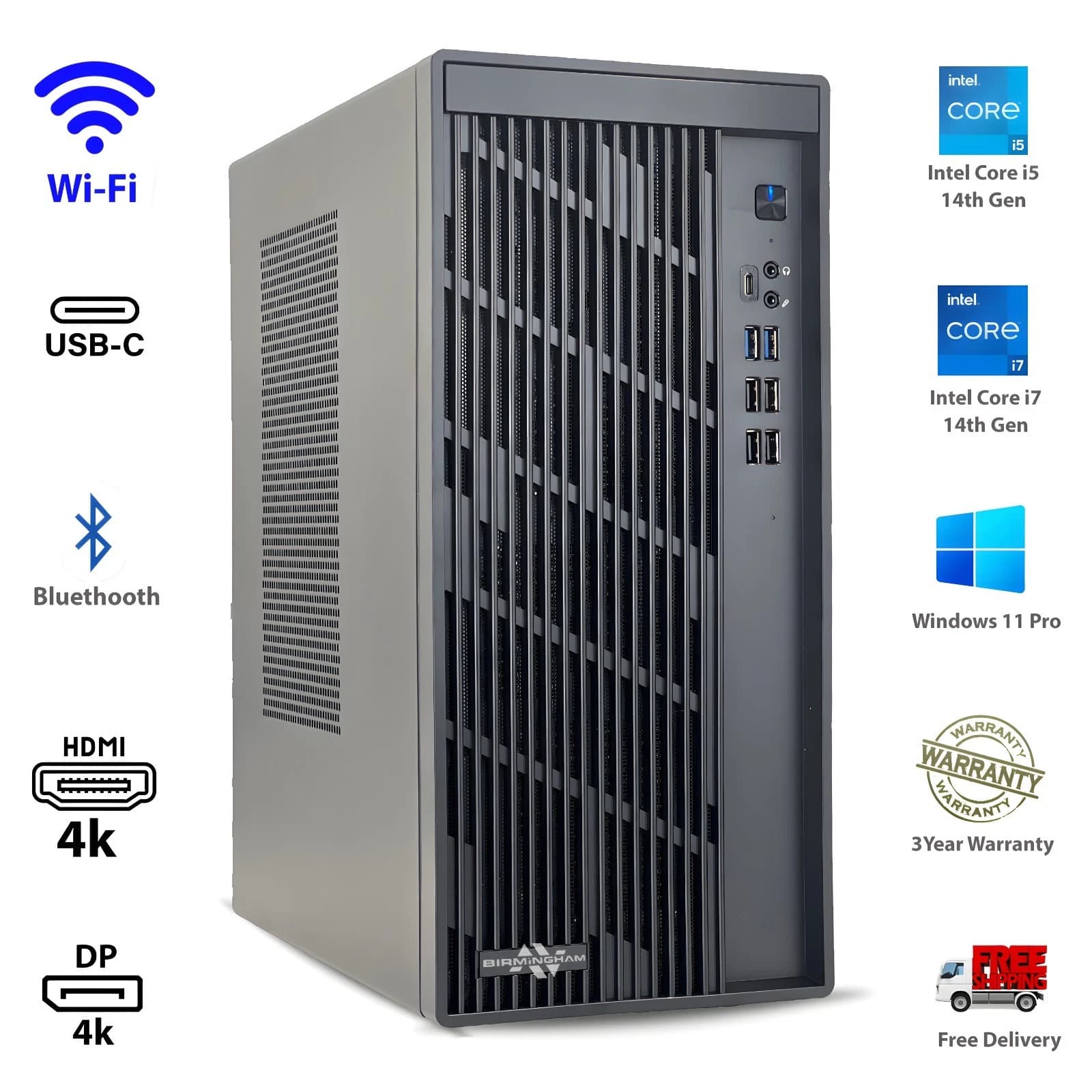
The Birmingham AV modern desktop range covers exactly this bracket. Configurations range across Intel eighth to twelfth generation Core i5 and i7 parts, 8 to 32 GB of RAM, and SSD capacities from 256 GB to 1 TB, all preloaded with Windows 11 and covered by a twelve month warranty. Prices land well below new hardware while delivering the responsiveness that makes an office PC feel modern.
How to think about buying in 2026
If the machine is a laptop that leaves the desk, an NPU equipped part is now worth paying for, because Windows Studio Effects and local transcription genuinely change the day to day experience.
If the machine is a desktop, an NPU is not a buying criterion. Prioritise CPU generation, RAM headroom, and SSD speed. A well specified refurbished tower running a twelfth generation Intel chip will feel faster in normal use than a thin and light laptop with a headline TOPS figure, because sustained clocks and thermal headroom still decide how a workstation performs when the workload is not neural inference.
For most small businesses the sensible split is a Copilot Plus laptop for the mobile users and a solid refurbished desktop for everyone at a fixed workstation. The total cost lands well below fitting the whole team with new premium ultrabooks.
FAQ
Do I need a Copilot Plus PC to use ChatGPT or Claude?
No. Cloud AI assistants run entirely on remote servers and only need a browser. The Copilot Plus badge only matters for on device features such as Recall, Live Captions with translation, and local image generation. If your AI use is cloud based, any modern PC is sufficient.
Will an NPU speed up Photoshop or video editing?
Selectively. Adobe has enabled NPU paths for specific tasks such as neural filters, generative fill previews, and some masking operations. Core rendering, timeline scrubbing, and export are still GPU and CPU bound, so a discrete graphics card remains the bigger lever for creative professionals.
Is the NPU worth it if I already have a good GPU?
For most users the GPU will win on raw throughput, but the NPU wins on power draw. On a laptop, running Studio Effects on the NPU rather than the GPU can save fifteen to twenty watts, which translates directly into longer battery life and quieter fans. On a desktop with mains power, the point is moot.
Can a refurbished desktop still handle modern AI workloads?
Yes, within reason. Cloud based AI works identically on any PC with a browser. For local inference of small models, a refurbished tower with a modest discrete GPU will run 7 billion parameter models comfortably. Larger models still belong to the cloud regardless of what hardware sits under the desk.
About Birmingham AV
Birmingham AV has sold 87,000 items on eBay since 2017 with 24,756 buyer feedbacks at 98.9% positive, making us one of the highest volume refurbished PC operations on eBay UK. Every system ships with a twelve month warranty and full UK support. Birmingham AV Ltd is registered at Companies House under company number 12383651, VAT number GB 348755066, based in Bromsgrove, Worcestershire.