Best refurbished PC for data scientists: Jupyter, PyTorch
The refurbished workstation that runs Jupyter kernels, trains PyTorch models locally, and keeps a CUDA pipeline honest without a fresh five figure spend.
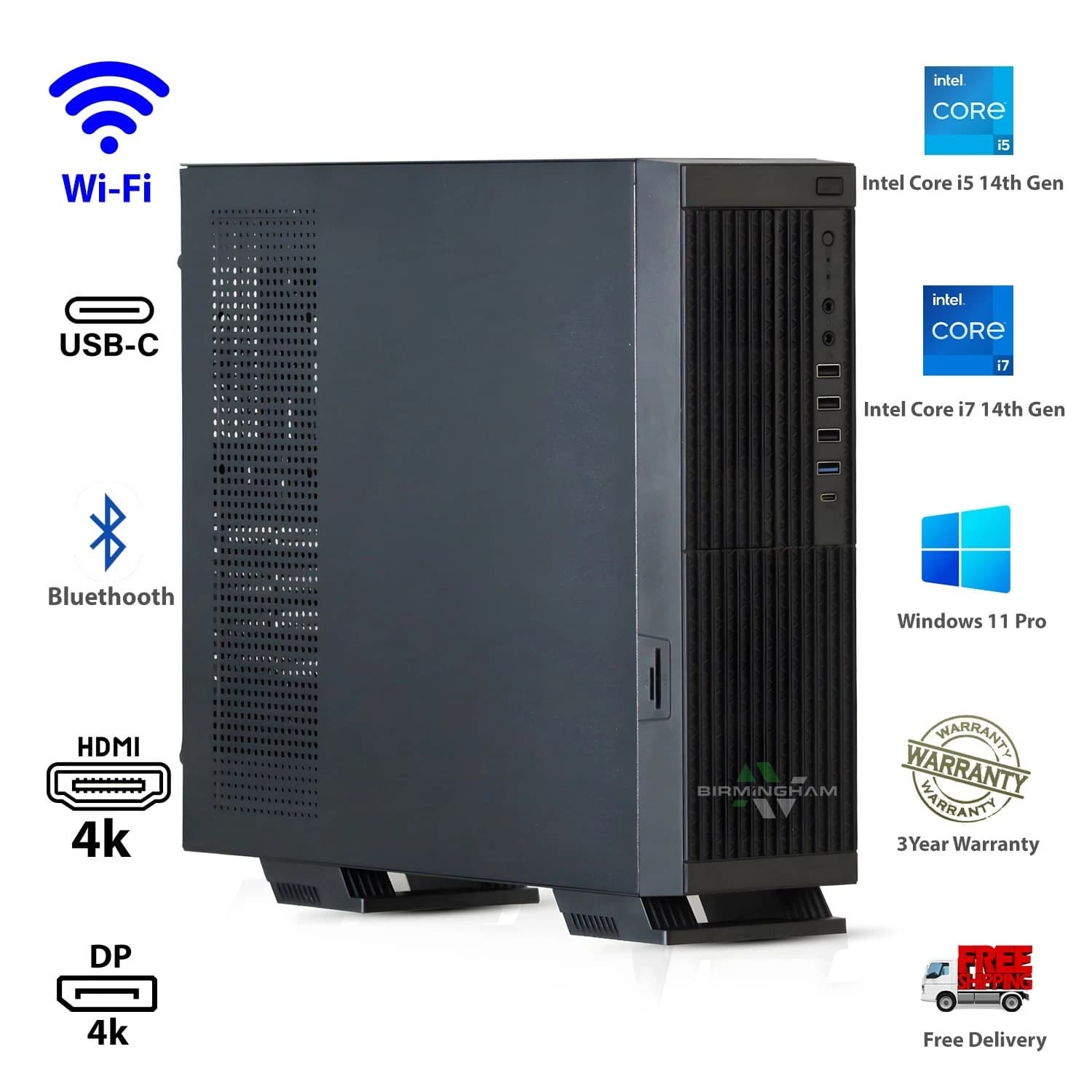
Data science on a laptop is fine until the moment you fit a transformer, tune a gradient boosted tree over half a million rows, or spin up a Stable Diffusion checkpoint. Then the fan noise starts, the kernel dies, and the cloud GPU meter begins ticking. A properly specified refurbished tower fixes the problem at a fraction of new retail, and for most working data scientists the refurbished RTX 5070 Ti build in the Birmingham AV catalogue is the honest answer.
This piece covers what that answer looks like in practice: the silicon, the memory, the storage, and why a used enterprise chassis beats a consumer prebuild for Jupyter and PyTorch.
What a data science workstation actually needs
A working data science box has to do four things at once: hold a large dataset in RAM without paging, feed a GPU fast enough to keep the CUDA cores busy, run notebooks and Docker containers on the CPU side without the kernel choking, and stay quiet enough to think through.
That means at least 64GB of DDR5, a modern CUDA capable GPU with 16GB of VRAM or more, an NVMe SSD, and a chassis with airflow. Consumer gaming rigs skip one or two of those. Carefully specified refurbished towers hit all four.
Why the RTX 5070 Ti is the right GPU tier
The RTX 5070 Ti sits in the sweet spot for local model work in 2026. It ships with 16GB of GDDR7 VRAM, the practical minimum for running a 7B parameter language model in FP16 without offloading layers to system RAM. It has enough tensor throughput to fine tune a Whisper model on a few hours of audio, or run a LoRA pass on Stable Diffusion XL overnight.
The tier below (RTX 5070, 12GB) forces 4 bit quantisation for anything above a 7B model. The tier above (RTX 5080 Super, 24GB) adds roughly £600 for headroom most working data scientists rarely use. The 5070 Ti is the correct compromise.
The BAV refurbished RTX 5070 Ti build, spec by spec
The Birmingham AV RTX 5070 Ti workstation ships in a range of configurations depending on chassis and CPU tier, but the core specification stays consistent:
- CPU: Intel Core i7 14700K or i9 14900K, sixteen or twenty four cores, base clocks from 3.4GHz and boost to 5.6GHz on the 14900K.
- RAM: 64GB DDR5 6000 MT/s in dual channel, upgradable to 128GB on boards with four DIMM slots.
- GPU: NVIDIA GeForce RTX 5070 Ti, 16GB GDDR7, PCIe 5.0 x16.
- Storage: 2TB NVMe Gen 4 SSD, with a spare M.2 slot and two SATA bays for cold storage.
- PSU: 850W 80 Plus Gold, headroom for GPU transient spikes.
- OS: Windows 11 Pro, dual boot friendly for Ubuntu 24.04 LTS.
Prices in this range sit between £1,899 and £2,349 depending on CPU tier, RAM capacity, and SSD size. Every unit ships with a twelve month warranty.
View the current RTX 5070 Ti data science build on eBay
Jupyter performance and CPU choice
Notebook kernels are single process by default, and much of the pandas, polars, or scikit-learn work inside them is CPU bound rather than GPU bound. The 14700K provides eight performance cores and eight efficiency cores. The 14900K provides eight performance cores and sixteen efficiency cores. For a data scientist running a Jupyter kernel, a browser with fifteen tabs, VS Code, and a Docker container hosting Postgres, the 14900K is worth the £150 uplift.
DDR5 6000 helps too, delivering roughly 96 GB per second of theoretical throughput per channel, well ahead of the DDR4 3200 in most refurbished workstations from a year or two ago.
PyTorch, CUDA, and storage in practice
The RTX 5070 Ti runs the CUDA 13 toolkit and cuDNN 9, both supported by PyTorch 2.6 and later. In practice that means:
- 7B parameter LLM inference at roughly 45 to 55 tokens per second in FP16.
- LoRA fine tuning of a 7B model completes in six to eight hours on a 50,000 example dataset.
- Stable Diffusion XL image generation at 1024 by 1024 completes in around four seconds per image at 30 steps.
- YOLOv9 object detection training on a 20,000 image dataset finishes in roughly twelve hours.
For anything larger, model parallelism across two GPUs or cloud offload remains the right call. But for the day to day work of a mid career data scientist, the 5070 Ti keeps the cloud meter switched off.
The 2TB NVMe Gen 4 boot drive delivers around 7,000 MB per second sequential reads, which matters when loading a 40GB Parquet file. The second M.2 slot is free for scratch, and the SATA bays take 4TB spinning disks for cold datasets. Every unit ships with Windows 11 Pro, though the hardware is validated against Ubuntu 24.04 LTS, either as dual boot or via WSL2 with the NVIDIA CUDA driver.
FAQ
Can this build train a 13B parameter LLM?
Fine tuning a 13B model with LoRA or QLoRA at 4 bit quantisation fits comfortably in 16GB of VRAM. Full precision training of a 13B model needs at least 40GB and belongs on cloud infrastructure or a dual GPU rig. For local development and rapid iteration, the 5070 Ti is enough.
How does refurbished compare to buying new?
A new equivalent build from a mainstream PC brand sits between £2,900 and £3,400 at current retail. The Birmingham AV refurbished units use the same generation of silicon, ship with a twelve month warranty, and undergo a 47 point test before dispatch. The saving is real, and the risk is bounded.
What about noise under sustained training load?
The 850W Gold PSU runs semi passive below 40 percent load, and the GPU idles fanless. Under sustained training load the chassis sits at roughly 38 dBA at one metre, quieter than most open plan offices. A Noctua NH-D15 upgrade is available for £75 if silence really matters.
Can the GPU be upgraded later?
Yes. The 850W PSU has headroom for a single RTX 5080 Super or 5090 upgrade down the line, and the chassis clears cards up to 340mm. Ask at time of order for the upgrade path to be guaranteed in writing.
About Birmingham AV
We are Birmingham AV Ltd, one of the highest volume refurbished PC operations on eBay UK. Since 2017 we have sold over 87,000 items on the platform, earned 24,756 buyer feedbacks at 98.9 percent positive, and built a twelve month warranty into every unit that leaves our workshop. We are registered at Companies House under 12383651, VAT registered as GB 348755066, and based in Bromsgrove, Worcestershire. Every workstation is tested, cleaned, and documented before dispatch.