Best PC for MSFS 2024 in VR
Microsoft Flight Simulator 2024 in VR is the most brutal consumer workload on the market. Here is what actually runs it, and what falls over.
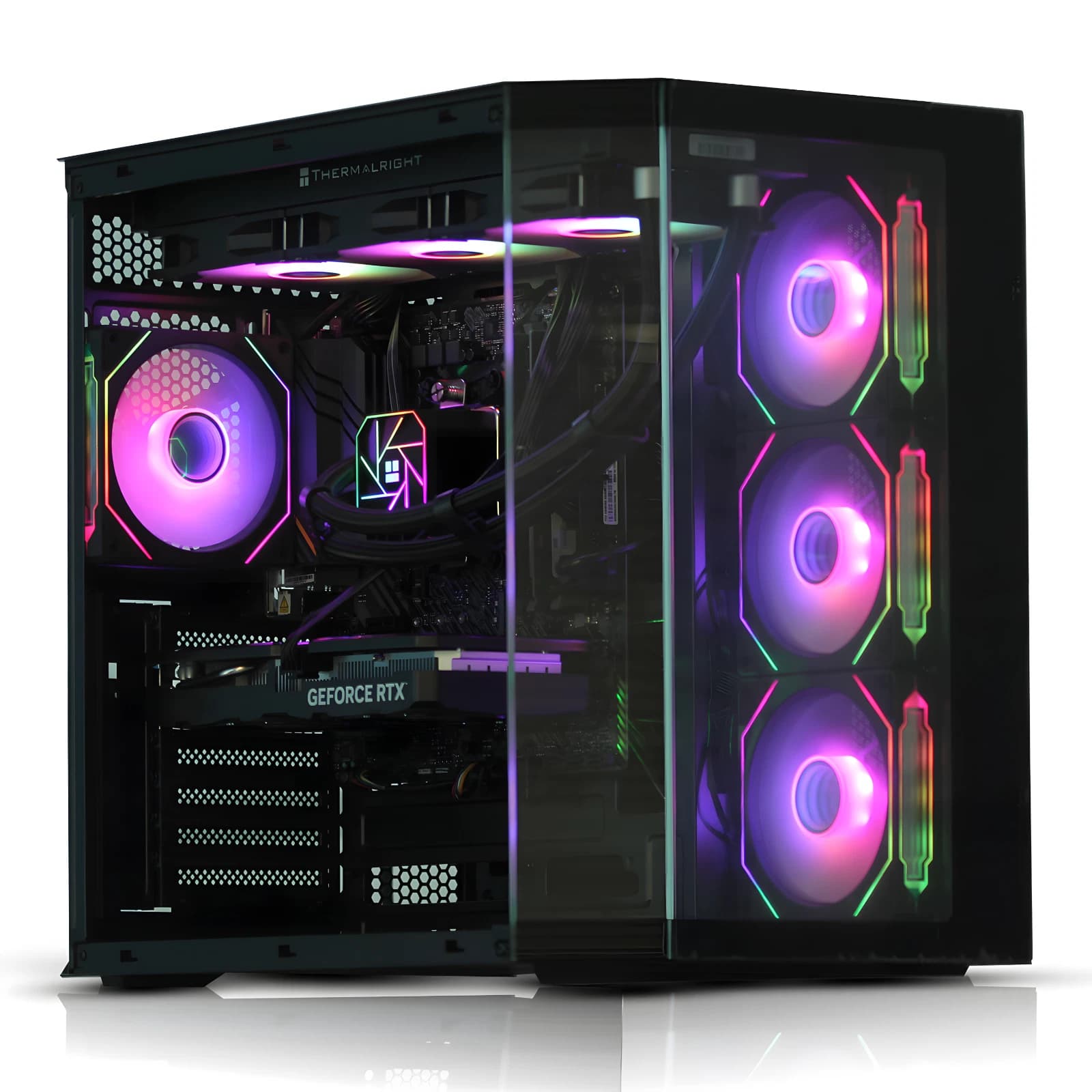
Microsoft Flight Simulator 2024 in VR is not a game in the normal sense. It is a streamed photogrammetry world, a heavy CPU simulation, and a stereoscopic render target that has to hit 90Hz on two eye buffers at once. Drop into central Tokyo in a heavy tube liner at dusk with a Quest 3 on your head, and every mid tier build in the country will fold.
Why MSFS 2024 in VR is a category of its own
Flat panel MSFS 2024 is already demanding. The 2024 title added streamed world data, denser vegetation, and improved building meshes. In VR the render load roughly doubles. A Quest 3 at native runs around 2064 by 2208 per eye. A Pimax Crystal Super sits closer to 3840 by 3840. Multiply that by the supersample most pilots use (1.3 to 1.5) and pixel counts land where no midrange GPU in 2026 can sustain them.
MSFS is also famously main thread bound. Single core throughput and cache size drive minimum frame rates over dense scenery, and low ones destroy the VR experience faster than average rates do. Reprojection helps, but introduces judder on yoke inputs that pilots feel immediately.
The GPU question: RTX 5090, or reproject and cope
Over photogrammetry areas (London, New York, Paris, Tokyo, San Francisco, Rome) with ultra settings and a modest supersample, the RTX 5090 is the only consumer card that holds a stable 45fps or higher and lets ASW or Motion Smoothing fill the gap to 90Hz cleanly. The 32GB of GDDR7 matters, because texture streaming spikes chew through 16GB and 20GB frame buffers when the sim pages in new tiles on approach.
An RTX 5080 with 16GB runs MSFS 2024 in VR only after dropping cloud quality to high, terrain LOD to around 150, and switching off traffic dense city rendering. An RTX 5070 Ti at 16GB is a flat panel card for this title, not a VR card. Below that, expect reprojection artefacts on every gentle turn.
The honest position: if VR MSFS 2024 is the reason for buying the PC, it is RTX 5090 or accept compromised settings.
The CPU: cache is king
For MSFS the CPU choice is settled. The Ryzen 7 9800X3D or Ryzen 9 9950X3D are the two builds that make sense at the top end. The stacked L3 cache on the X3D parts feeds the sim's main thread in a way raw clock speed does not. Upgraders from a 7800X3D report 15 to 25 per cent gains in 1 per cent lows over dense scenery, which in VR is the difference between comfortable and nauseating.
Intel's Core Ultra 9 285K loses to the X3D chips in this workload by a meaningful margin. For an MSFS 2024 first build, do not spend the money on Intel this generation.
RAM and storage
64GB of DDR5 6000 CL30 is the sensible floor for a serious MSFS 2024 VR rig. The sim uses 40GB plus in dense scenery with add on aircraft, and Windows plus SimBrief plus Navigraph will eat the rest.
A 2TB Gen 4 NVMe (Samsung 990 Pro, WD SN850X, Crucial T500) as the primary drive, plus a 4TB Gen 4 for the community folder, is a realistic layout. Cheap QLC drives throttle hard when the SLC cache runs out mid flight.
See current Birmingham AV specialist tower stock on eBay for the RTX 5090 and 9800X3D builds that ship configured for exactly this workload.
The Birmingham AV recommendation for MSFS 2024 in VR
The build specified for VR flight sim customers sits at the top of the current stack:
- CPU: AMD Ryzen 7 9800X3D or Ryzen 9 9950X3D
- GPU: Nvidia RTX 5090 32GB
- RAM: 64GB DDR5 6000 CL30 (Corsair Vengeance or G.Skill Trident Z5)
- Storage: 2TB Samsung 990 Pro Gen 4 NVMe plus 4TB secondary NVMe
- PSU: 1000W to 1200W 80 Plus Platinum (Corsair RM1000x or Seasonic Prime)
- Cooling: 360mm AIO on the CPU, high static pressure case fans, mesh front panel case
- Motherboard: X870E chipset with PCIe 5.0 to the GPU slot
Realistic street pricing lands in the £3,800 to £4,600 range depending on GPU stock and cooling choice. Anyone quoting an RTX 5090 VR rig below £3,500 is cutting corners on PSU, cooling, or memory speed.
For pilots on a tighter budget, a Ryzen 7 9800X3D with an RTX 5080 16GB, 32GB DDR5, and a Quest 3 at reduced supersample delivers a genuinely enjoyable experience in most of the world. That build sits closer to £2,400 to £2,800.
Headset pairing
The Quest 3 is the value pick and pairs well with either build via Virtual Desktop or Air Link, provided the router is Wi Fi 6E on a dedicated 6GHz channel. The Pimax Crystal Super and Varjo Aero are the picks for panel legibility on glass cockpits, but demand the RTX 5090 build to run acceptably. HP Reverb G2 stock has dried up on the UK market and is no longer a viable recommendation.
FAQ
Will an RTX 5080 run MSFS 2024 in VR?
Yes, with compromises. Expect terrain LOD around 150, cloud quality on high not ultra, and traffic dense mode off over major cities. Rural scenery holds up, but heavy photogrammetry approaches push the 16GB frame buffer to its limit.
Is 32GB of RAM enough for MSFS 2024 in VR?
Not for a serious setup. 32GB works if MSFS is all that is running, but add on aircraft, weather engines and Navigraph tools consume more headroom than most builders expect. 64GB is the correct answer for a build meant to last three to four years.
Does the 9950X3D beat the 9800X3D for MSFS?
In most cases the 9800X3D matches or narrowly leads the 9950X3D because MSFS is bound by single thread performance on the cache loaded CCD. Pick the 9950X3D only if streaming, encoding or a busy simulation stack runs alongside the sim.
Can I use a used RTX 4090 instead of a new RTX 5090?
The RTX 4090 with 24GB remains a competent MSFS 2024 VR card and saves around £500 to £700. The trade offs are lower raw performance in cities, no DLSS 4 multi frame generation, and warranty risk on a used card that has likely been under heavy load. The RTX 5090 is the safer route for headroom.
About Birmingham AV
We are Birmingham AV Ltd, one of the highest volume refurbished PC operations on eBay UK. We have sold over 87,000 items on the platform since 2017, with 24,756 buyer feedbacks at 98.9 per cent positive. Every tower we ship carries a full twelve month warranty. Companies House registration 12383651, VAT number GB 348755066, based in Bromsgrove, Worcestershire.