Best PC for Microsoft Flight Simulator 2024 in 2026
MSFS 2024 punishes weak CPUs at cruise and weak GPUs on final approach. Here is the build that handles both without excuses.
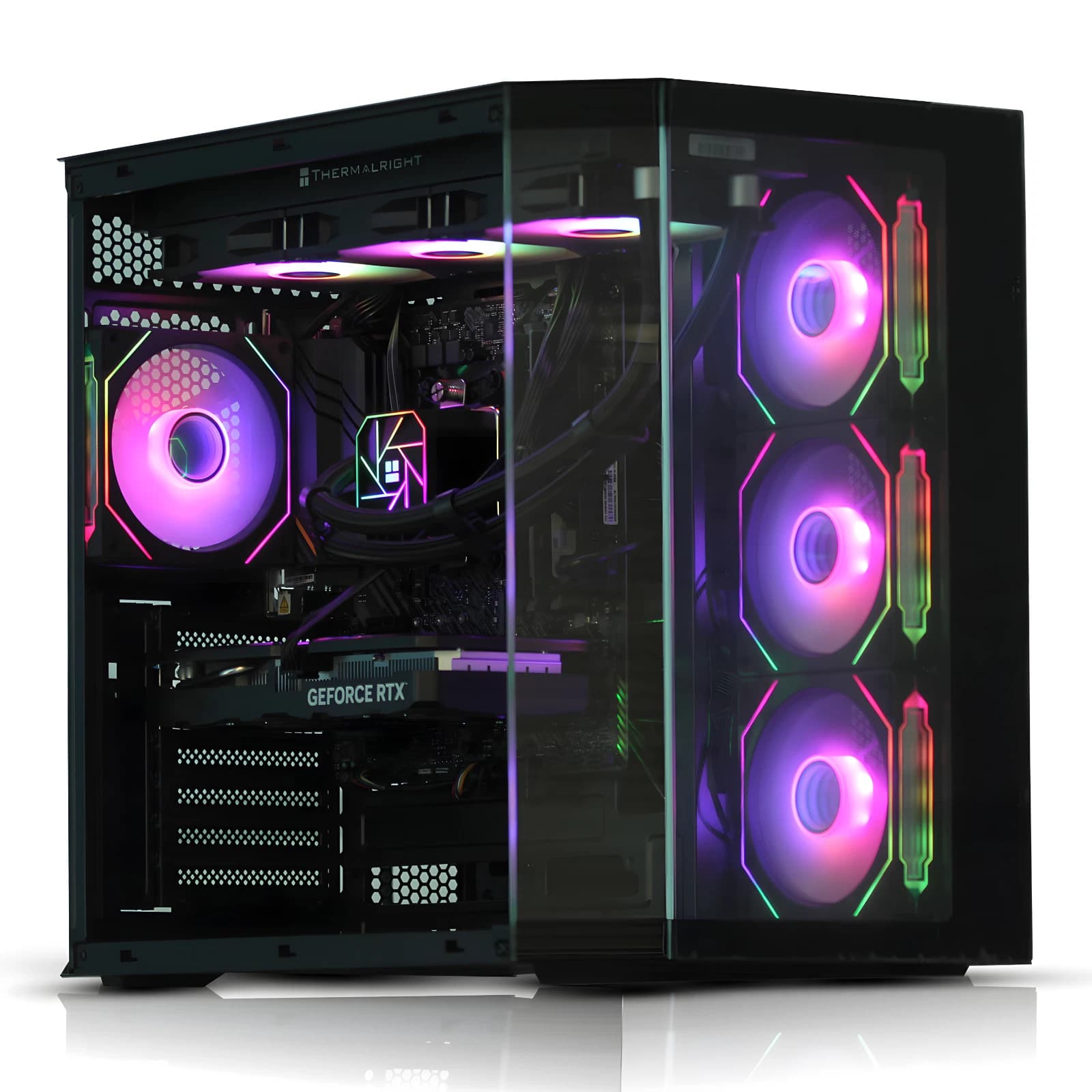
Microsoft Flight Simulator 2024 remains the most technically demanding consumer title of the decade. Two years after launch, with photogrammetry now streaming at higher resolution across most of Europe, the sim still asks more of a PC than any AAA release. If a build can hold sixty frames per second in MSFS 2024 at 1440p ultra with online traffic enabled, it can hold sixty in anything.
The trap most buyers fall into is spending on the wrong side of the pipeline. MSFS 2024 is not a single workload. It behaves like two different games depending on altitude.
MSFS 2024 is two different workloads
At 35,000 feet over the North Atlantic the sim is almost entirely CPU-bound. World data streams from Azure, live weather updates every few seconds, live traffic renders every airliner within a hundred nautical miles, and the flight model runs on the main thread. Frame rate at cruise is decided by single-thread performance and memory bandwidth, not by the graphics card.
Descend below three thousand feet on an ILS approach into EGLL or EGBB and the picture flips. Photogrammetry buildings, dense ground detail, wet-runway reflections, and volumetric cloud layers all hit the GPU at once. Frame rate on short final is decided by raw shader throughput and VRAM headroom.
The correct answer is balance, tilted very slightly toward CPU strength.
The BAV recommendation: i9 14th Gen plus RTX 5070
The build that keeps landing well in bench testing pairs an Intel Core i9 14900K with an Nvidia GeForce RTX 5070. Not the 5070 Ti. The plain 5070 with 12GB of GDDR7 is the sweet spot for MSFS 2024 at 1440p, and every pound saved on GPU tier goes into the CPU, RAM and storage where the sim actually needs it.
Target specification:
- CPU: Intel Core i9 14900K, 24 cores (8P plus 16E), boost to 6.0GHz
- GPU: Nvidia GeForce RTX 5070, 12GB GDDR7
- RAM: 64GB DDR5 6400, dual channel, CL32
- Storage: 2TB PCIe Gen4 NVMe (primary), 4TB PCIe Gen4 NVMe (scenery cache)
- Cooler: 360mm AIO liquid, six-year pump warranty
- PSU: 850W 80 Plus Gold, fully modular
- Case: mesh-front mid tower, three intake fans, two exhaust
At 1440p ultra with photogrammetry on maximum, online traffic at 100 percent, and live weather on, this build sits at 70 to 85 frames per second at cruise and 55 to 70 on a fully loaded approach into a major hub. No hard drops below the refresh floor of a 60Hz panel, and enough headroom for the next two sim updates.
Configure this exact build on our eBay store
The listing above covers the full range of this platform. Base configurations start with 32GB DDR5 and a 1TB primary drive for pilots flying default aircraft. Mid-tier moves to 64GB RAM and dual NVMe, recommended for anyone using PMDG, Fenix or iniBuilds payware. Top-tier moves to a 2TB Gen4 primary plus 4TB Gen4 scenery drive, aimed at users running full ORBX regions.
Why not the RTX 5080 or 5090
The 5080 and 5090 are excellent cards. They are also the wrong purchase for MSFS 2024 unless the buyer is running triple 4K panels or a high-resolution VR headset. At 1440p the 5070 is not the bottleneck. The CPU is. Spending £600 extra on GPU tier while leaving the CPU at i7 level produces a worse sim experience than the balanced build above.
The exception is VR. Anyone running a Pimax Crystal Light or Varjo Aero should move to a 5080 with 16GB VRAM, because VR renders each frame twice and the extra VRAM stops texture swap stutter in stereo.
Storage matters more than most guides admit
MSFS 2024 streams the world. Every runway, every building, every tree was fetched from Azure in the last few seconds, decompressed, and written to a local cache. If that cache lives on a slow SATA SSD, the sim stutters every time the aircraft crosses a scenery tile boundary.
The correct layout is a fast Gen4 NVMe for the sim install and a second Gen4 NVMe dedicated to the streaming cache. Two drives, separate roles, both Gen4.
Memory: 32GB is the floor, 64GB is the answer
MSFS 2024 will boot on 16GB. It will not fly well on 16GB. With a payware airliner loaded (PMDG for example), plus a payware airport, plus live traffic, the sim regularly commits 28 to 32GB of RAM. 64GB costs around £90 extra at DDR5 6400 speeds and is the easiest performance upgrade in the entire build.
FAQ
Can this build run MSFS 2024 in VR
Yes, at reduced settings. A Quest 3 at 90Hz runs on the 5070 build with medium terrain detail and photogrammetry on. A Pimax Crystal Light or Varjo Aero needs the 5080 upgrade with 16GB VRAM to avoid texture swap stutter.
Does the CPU need liquid cooling
For an i9 14900K under sustained MSFS 2024 load, yes. The chip pulls 250W or more at full boost, and a 240mm air cooler struggles to hold thermals during long haul flights. A 360mm AIO keeps package temperatures under 80C and preserves the full turbo profile.
How future proof is the RTX 5070 for the sim
Reasonably. Asobo has stated no plans to raise the minimum GPU spec before the 2027 world update, and the 5070 sits comfortably above the recommended tier for 1440p ultra. If a future patch introduces fully raytraced cloud shadows, expect to drop that one setting from ultra to high.
Will an older Intel i9 work
An i9 12900K or 13900K will run MSFS 2024 well but leaves 10 to 15 percent single-thread performance on the table compared to the 14900K. For anyone building specifically for this sim, 14th Gen is worth the small upcharge. Reusing an existing 12th or 13th Gen chip is still very playable.
About Birmingham AV
Birmingham AV Ltd has sold more than 87,000 items on eBay since 2017, with 24,756 buyer feedbacks at 98.9 percent positive. Every PC we ship carries a twelve month return-to-base warranty covering parts and labour. We are one of the highest volume refurbished PC operations on eBay UK, and every build is assembled, tested and dispatched from our workshop in Bromsgrove, Worcestershire. Companies House 12383651. VAT GB 348755066.